
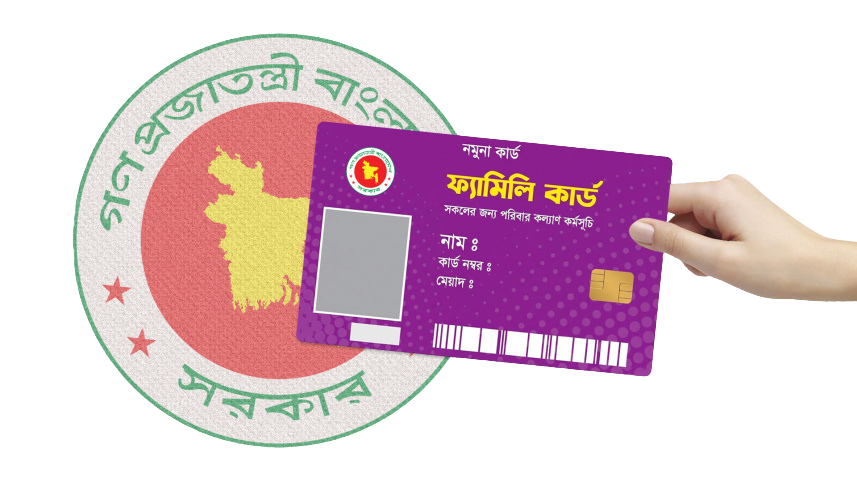
The Family Card is a database-driven digital identification and social protection instrument designed to deliver regular financial assistance directly to vulnerable households. More than just a cash transfer mechanism, it is envisioned as a universal social safety platform that integrates multiple welfare services under a single identity instrument.
Core Philosophy
"Family is the core unit of development, not the individual." The programme shifts the design logic of social protection from targeting individuals to supporting the household as a whole; recognizing that poverty, food insecurity, health shocks, and economic vulnerability are experienced collectively.
Programme at a Glance
| Implementing Ministry | Ministry of Social Welfare, Government of Bangladesh |
| Programme Type | Digital cash transfer + subsidised commodities access |
| Cash Benefit | BDT 2,000 – 2,500 per family per month |
| Target Coverage | Up to 2 crore (20 million) families nationally |
| Pilot Launch | March 10; covering 6,500 families in 14 upazilas |
| Transfer Mechanism | Mobile Financial Services (bKash, Nagad, Rocket) or bank account |
| Card Issuance | One card per household; issued in the female head’s name |
| Selection Method | Proxy Means Test (PMT) scoring + door-to-door data collection |
| Long-Term Vision | Universal Social ID Card for every citizen by 2030 |
| Fiscal Target | Social protection budget raised to 3% of GDP by 2028 |
Three Strategic Pillars
💵 Direct Cash Transfer
- Monthly BDT 2,000-2,500 deposited digitally
- No intermediaries
- Reduced corruption risk.
🆔 Universal Social ID
A single smart card enabling access to
- Subsidized food
- Education stipends
- Agri-support by 2030.
📊 Dynamic Social Registry
- A unified database replacing fragmented records
- Integrating 99 existing programmes across the ministries/divisions
Who Qualifies?
Inclusion Criteria
- Rural families owning 0.50 acres or less of homestead and cultivable land
- Households assessed as poor or ultra-poor based on income and asset evaluation
- Landless, homeless, persons with disabilities, and marginalized communities (including Hijra, Bede, and small ethnic groups)
Exclusion Criteria
- Any family member who is a regular government employee or pensioner
- Households with a commercial license or large business operations
- Families possessing a car or air conditioner
Priority Groups
Implementation begins with the most vulnerable segments; the ultra-poor, homeless, persons with disabilities, and socially marginalized communities. Despite the programme's universal ambition, targeting starts at the bottom of the economic ladder.
How Beneficiaries Are Selected
Selection follows a structured, multi-level process to minimize patronage and ensure accountability:
| Data Collection | 560 supervisors collect 50 data points per family across 320,000 households in 14 pilot wards |
| Scoring Method | Proxy Means Test (PMT); a scientific poverty assessment tool using income, asset and livelihood indicators |
| Verification | Social services staff verify field data; QR-coded cards are issued post-selection |
| Selection Committees | Formed at city, upazila, union, municipality, and ward levels for decentralized accountability |
| Oversight | A two-tier government checking system monitors the process for errors and duplication |
| Timeline | Data collection by end of June; 40,000 beneficiaries selected in Phase 1 |
Pilot: Phase 1 Coverage
The pilot phase launched on March 10 covers 14 upazilas across Bangladesh, selected to represent both urban slum populations and rural districts:
| Dhaka (Urban) | Banani (Korail, Sattala, Bhashantek slums); Mirpur/Shah Ali (Oli Miar Tek, Baganbari slums) |
| Chattogram | Patenga |
| Khulna | Khalishpur |
| Sylhet Division | Derai (Sunamganj) |
| Barisal Division | Charfesson (Bhola) |
| Rajshahi Division | Bogura Sadar, Lalpur (Natore), Nawabganj (Dinajpur), Thakurgaon Sadar |
| Rangpur Division | Thakurgaon Sadar |
| Dhaka Division | Pangsha (Rajbari), Banchharampur (Brahmanbaria), Bhairab (Kishoreganj) |
| CHT Region | Lama (Bandarban) |
Key Design Features
Women as Primary Recipients
Cards are issued in the name of the mother or female head of household. Global evidence strongly supports this; transfers routed through women are more likely to be spent on food, healthcare, and children’s education, while also strengthening intra-household bargaining power.
Digital-First Delivery
Disbursements occur via mobile financial services (bKash, Nagad, Rocket) or bank accounts. Digital transfers eliminate middlemen, reduce leakage, and create an auditable payment trail; critical for a programme of this scale.
One Card, One Household
To prevent duplication a persistent problem in Bangladesh’s fragmented welfare ecosystem only one Family Card is issued per household, linked to a single registered family identity.
Beyond Cash: Integrated Benefits
Using OTP-verified smart cards, beneficiaries can also access subsidized essential food items through TCB integration. The roadmap includes education stipends and agricultural subsidies on the same platform, reducing the need for separate registrations and multiple cards.
Fiscal & Structural Context
Bangladesh currently operates 99 social safety net programmes across 25 ministries, with a combined budget of BDT 1.26 lakh crore (approximately USD 10.36 billion); 1.87% of GDP this fiscal year. Despite this scale, structural weaknesses persist:
- Fragmentation and weak inter-ministerial coordination lead to duplication
- An estimated 22-25% of the actual poor are excluded from existing programmes
- Programme design has grown in pieces rather than as a coherent system
At full scale, covering 2 crore families, The Family Card would cost approximately BDT 5,000 crore per month (about USD 410 million), or BDT 60,000 crore annually (around USD 4.9 billion). This represents a macro-level fiscal commitment with significant long-term implications for budget planning.
Fiscal Ambition
The programme's guideline targets raising the social protection budget to 3% of GDP by 2028, up from the current 1.87%. Achieving this would require sustained political commitment and fiscal headroom; making implementation quality the central test.
Strategic Significance
The Family Card is significant for two reasons beyond its immediate relief function:
- Reaching 2 crore families under monthly support would be a historic expansion of Bangladesh’s social contract: with systemic implications for poverty data, fiscal planning, and service delivery infrastructure.
- The Dynamic Social Registry and Universal Social ID ambition could solve a core governance problem: a fragmented social protection system that serves political convenience more than human need. If implemented with integrity, it changes how the state sees, and serves, its poorest citizens.
The Family Card should therefore be understood not simply as another social protection programme, but as a platform with the potential to reorganize how welfare is delivered in Bangladesh. Its success will depend less on the ambition of its design and more on the quality of its implementation: how beneficiaries are identified, how securely and accurately data is managed, whether digital delivery mechanisms reach households with limited technological access, and whether the intended integration of 99 existing programmes is realistically achieved. The pilot phase beginning in March 2026 will provide the first practical indication of whether this vision can translate into an effective and accountable system.